Tuesday, March 6, 2012

3.13 - Dana Marterella

Dana Marterella
March 13, 2012
at 12pm
Kaufman Conference room, 160

Descamisados:  Representations of the Body in the Evita Museum


Through an analysis of the Evita Museum in Buenos Aires, this presentation will explore the ways in which the body is represented and theorized as a site of national memory.

Dana Marterella is an associate professor of English and Humanities at Glendale College.  She is a PhD student in UCLA's Department of World Arts and Cultures/ Dance, where she researches themes of nationalism in literature, visual art and iconography in Latin America.

2.28 - CedarBough Saeji

February 28, 2012
in 12pm
Kaufman room, 160

CedarBough Saeji

A Case Study of Mask Dance Drama Students:
Capitalizing on Korean Heritage?

Monday, February 20, 2012

2.21 - Amy Smith of Headlong Dance Theatre (Philadelphia)

Amy Smith, Co-Director of Headlong Dance Theater (Philadelphia)
Headlong Dance Theater: Sharing the Work
February 21, 2012
at 12pm
Glorya Kaufman Dance Theater (room 200)

Amy Smith, a founding Co-Director of Headlong, will share some of the results of their artistic research over the past several years. She will talk about the role of the artist in our culture, and share images and video from Headlong’s recent works, especially those working with non-traditional sites
and involving audience/citizen bodies. For example: “CELL”, an experiential journey for one audience member at a time, guided by their cell phone; “Explanatorium”, a performance ritual in an abandoned church involving the entire audience; and “Red Rovers”, half performance, half Mars rover driver conference.

Amy Smith is a Co-Director of Headllong Dance Theater ,Philadelphia-based contemporary dance company. Since 1993, Headlong has created collaborative dance theater works and toured nationally.
Amy met her fellow Co-Directors Andrew Simonet and David Brick, in the Dance Department at
Wesleyan University. After college, she spent a year studying at the Center for New Dance
Development in Holland. Besides Headlong, Amy has performed in the work of Deborah Hay, Ishmael Houston Jones, and other choreographers. She has also performed extensively in theater and cabaret,
and she has won both a Barrymore (for 1812's Suburban Love Songs) and a Bessie (for Headlong's
“ST*R W*RS”). She recently played the role of Jane Fonda in Theater Exile’s production of That Pretty Pretty and choreographed an opera, The Cunning Little Vixen. She has taught and lectured at Rutgers, Drexel, Stephens College, and many other colleges and institutions. She worked for many years doing business management in the for-profit world, and she currently serves as Treasurer on the Dance/USA board of Trustees. In 2008, Headlong started the Headlong Performance Institute a fall semester performance training program for young artists in college (offering full credit) and post-bacs.

2.14 - April Rose Burnam

April Rose Burnam
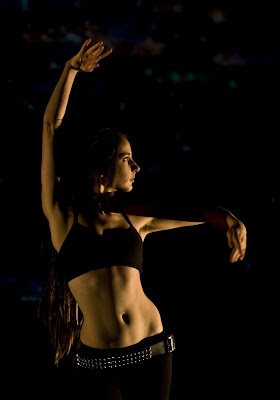
Constructing Self and Community through Improvisational Tribal Style Bellydance
February 14, 2012
at 12pm
Kaufman studio, 214

Improvisational Tribal Style Bellydance is a form of bellydance practiced around the world today that started in the US in the early 21st century. This dance is evidence that the transnational practice of bellydance continues to promise personal transformation and a sense of community for its practitioners.  In the experience of dancing this structured improvisational form, the dancers put themselves in a situation where the possibility of falling out of unison with one other is confronted repeatedly by the group.  They manage to maintain their group integrity, the choreography, and their relationships to one another, out of which a sense of community is formed and strengthened again and again. I argue that the experience of dancing this form helps to construct a particularly secure and responsive self. Come to witness a live group demonstration, short video presentation of interviews, and snippets of my research.  Please offer your thoughts, connections, and questions for further exploration.

April Rose is working toward her Masters degree in Culture, Performance, and Dance at UCLA?s World Arts and Cultures|Dance Department, where she has also earned a BA in Dance.  Her research explores the many permutations of bellydance practice in the post-1960?s US: in specific, bellydance as a practice that enacts a tension between the potential for personal transformation and social transgression and its tendency to fail in fully reaching that potential.

April took a leave of absence in 2010/2011 to tour internationally with The Bellydance Superstars and was been a performing member of UNMATA for 5 years.  April Rose began Egyptian/American Cabaret (or Raqs Sharqi) bellydance as a child.  She was lucky enough to be immersed in the practice as an adolescent at a time when its underground, punk rock, queer, and 90?s-feminist tendencies had just begun to emerge.  She currently travels abroad on a near monthly basis to teach, speak, and perform at bellydance conferences and teaches three nights a week in LA.  Her life is dedicated simultaneously to bringing into bellydance the theoretical, historical, and compositional knowledge she has gained in WAC and to making people understand the potential bellydance has for thoughtful self expression, community formation, and the challenging of social convention.

www.aprilrosedance.com

Friday, February 3, 2012

2.7 - Carl Schottmiller

If These Stalls Could Talk:  Gendered Spaces and Identity Construction
in Latrinalia
at 12pm
Conference room, 160

Latrinalia (restroom graffiti) scholarship spans disciplines and
generations:  from sexologist Alfred Kinsey to psychoanalytic
folklorist Alan Dundes, scholars have studied latrinalia as revealing
the inner psychological workings of "deviant" subjects.  This project
shifts its analytical focus away from the unknowable graffiti producer
to the consumer.  With a methodology derived from phenomenology,
queer/gender theories, and folkloristics, this presentation
investigates how consumers through engagement with and interpretation
of graffiti produce subjectivities for the unknown producers.  Looking
at documented latrinalia images and interviews with consumers, this
project theorizes latrinalia as spatial tactics through which subjects
may uphold hegemonic notions of gender or deconstruct these notions
through engagement with latrinalia.


Carl Schottmiller is a Culture and Performance Ph.D. student at the
department of World Arts and Cultures/Dance in the University of
California, Los Angeles. He holds a MA degree in Folklore from the
University of California, Berkeley.  This presentation is derived from
his MA thesis of the same title.  Carl?s research interests include
phenomenology, queer corporeal representations, and drag as a
therapeutic tactic for anxiety and body image disorders.

Tuesday, January 31, 2012

1.31 - I-Wen Chang

Throwing Out Leader-Follower Rules: Gender-shifting in Taiwanese Salsa Today
12pm
Conference room, 160

Salsa is a transnational and transcultural dance form that has
traveled from the Americas to many other countries. In the past five
years, it has become a craze among young professionals in Taiwan.
Inevitably, salsa is represented differently in various cultural
contexts. In this paper, I argue that the notion of "flow" in salsa
practice, the Confucian discipline of the female body, and the
economic accessibility of salsa in Taiwan are contextual elements
without which it is impossible to situate the social meaning of salsa
dancing in Taiwan in its proper light. In the Taiwanese salsa scene,
not only do female salsa practitioners gain agency and assert their
power to challenge traditional values, but male salsa practitioners
also find a space to perform and enjoy their femininity without being
judged. There are two imperatives for this study: 1) to subvert the
dominant notion in academia about the immobile gender rules at play in
salsa; 2) to illustrate the diversity salsa practice using Taiwan as a
case study where it has not yet been discussed in the growing
scholarship on Asian performance.

I-Wen Chang is a Culture and Performance Ph.D. student at the
department of World Arts and Cultures/Dance in the University of
California, Los Angeles. She holds a MA degree in Art Theory and
Criticism from the Taipei National University of the Arts. Her master
thesis is titled "Beyond Representation: Interpreting Pina Bausch's
Dance Theater and Its Significance to the Contemporary Arts." I-Wen is
a trained Chinese folkdancer and salsa dancer. Her research interests
include phenomenology in social dance, corporeal representations,
gender issues, cultural hegemony, and post-colonialism. Specifically,
she focuses on how pair-dancing becomes a means of communication and
enables social mobility, how corporeal practices construct national
identity, how the Taiwanese encounter the West through corporeal
practices under globalization, and how salsa is represented
differently in various cultural contexts. I-Wen is the special
correspondent for the Artistic Magazine (Taiwan), the art critic for
the ARTCO (Taiwan), and the co-editor of a Taipei based experimental
dance semi-annual periodical titled BINDO PAPER."

Tuesday, January 17, 2012

1.24 - Meena Murugesan

Please join us at our next
Chew on This

Meena Murugesan
split/focus (13-min)
January 24, 2012
Kaufman studio 214


split/focus is a solo contemporary Indian dance work that strives to connect multiple meanings and points of focus. Can seemingly disparate objects/subject /concepts come into focus simultaneously? (background/foreground) Where is one's point of focus? (mudhra/nritta) Where can fragments of emotion, technique and meaning intersect? (abstract/narrative)

Feedback session facilitated by Shyamala Moorty of Post-Natyam.

Choreographic Consultant/Mentor: Professor Janet O'Shea (LA)
Sound Composer: Kaveh Nabatian (Mtl)
Lighting Designer: Lee Anholt (Mtl)
Movement Consultant: Shyamala Moorty (LA)
Rehearsal Director: Nova Bhattacharya(Toronto)

Meena's multi-disciplinary performance practice is fuelled by her
commitment to dance, visual imagery, personal transformation and social
change. Her hybrid choreographic vision stems from twenty-four years of
training in bharatanatyam, four years of study in afro-contemporary dance
and street dance forms, a decade of creating visual imagery and five years
of training in eastern energetic bodywork.

Meena's recent choreographies include *pou/voir* (25-minutes, 2011), *
reBuild* (15-minutes, 2009), *whirling wailing woman* (10-minutes, 2009), *
AVAL* (26-minutes, 2008), *Unravelled* (50-minutes, 2006), in addition to a
dozen other collective creations and numerous improvised live performances.
Since 2004, she has performed her work in Montreal, Toronto, New York,
Niger, Chile and Brazil.

Parallel to Meena's dance career, she is also a community arts educator with ten years of local and international experience collaborating with under-represented groups such as youth, people of colour and incarcerated women using video and movement.

Currently, Meena is an MFA Dance candidate at the University of California
in Los Angeles in the World Arts and Cultures/Dance department. She is also
working on a commission for the CanAsian Dance Festival (Toronto) to
premiere in February 2012.


Janet O'Shea: Mentor/Choreographic Consultant
Janet O'Shea is the author of *At Home in the World: Bharata Natyam on
the Global Stage*(Wesleyan University Press 2007) the co-editor the *Routledge
Dance Studies Reader* (second edition) (2010), and a co-editor of the *Routledge
Online Encyclopedia of Modernism*. She has studied and performed bharata
natyam since 1988, while simultaneously pursuing it as a subject of
scholarly inquiry and is currently investigating ways of integrating her
study of this classical form with her ongoing interest in modern and
postmodern dance. She is Associate Professor in the department of World
Arts and Cultures at the University of California, Los Angeles.

Kaveh Nabatian: Sound Composer
Kaveh is an award-winning filmmaker and musician based in Montreal. With degrees
in both Film Production and Jazz Studies from Concordia University, he
has directed both fiction and documentary films, music videos, and
television series. His films have played at over thirty international
festivals, from which he has won numerous awards. Much of his time as a
musician is dedicated to Bell Orchestre, an avant-chamber ensemble in which
he plays trumpet, keyboards, and an array of analog and electronic
instruments. Bell Orchestre has released two critically-acclaimed albums,
won a Juno award, toured Europe and North America extensively, collaborated
with the Brooklyn Symphony Orchestra and LaLaLa Human Steps, and done a
composition residency at the Banff Centre for the Arts. Kaveh also plays
with Little Scream and composes music for films (including his own),
orchestra, dance, and theatre.

Lee Anholt: Lighting Designer
Lee Anholt graduated from Simon Fraser University in 1990 with a BA in
Contemporary Dance. He has been lighting for dance since 1995 and has been
touring extensively since 2000. He has worked with Peggy Baker, Montréal
Danse, José Navas, Margie Gillis and Marie Chouinard among others. Lee has
also designed lights for various independant choreographers, including
Chanti Wadge, Chantal Lamirande, and others. He is currently working with
Louise Lecavalier. Lee likes beer and frisbee.